

News
Engineering the Extremes: Why the Fused Quartz Glass Tube is Irreplaceable in Modern Industry

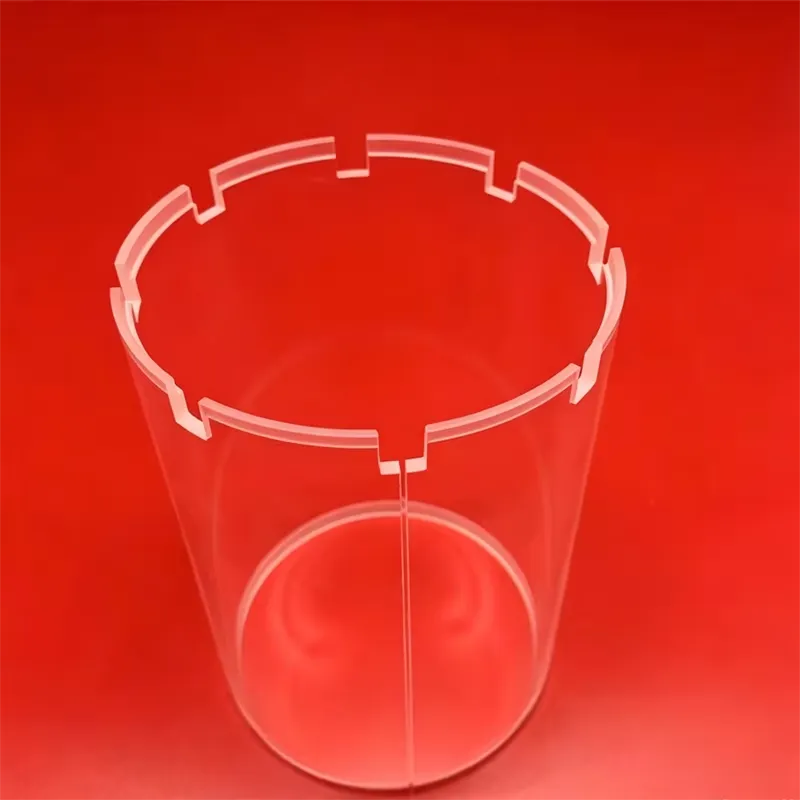
In high-tech manufacturing, materials are constantly pushed to their absolute physical limits. Imagine an environment where a component must simultaneously survive the blistering heat of a semiconductor furnace ($1,200^\circ\text{C}+$+), withstand the aggressive bite of boiling industrial acids, and maintain flawless optical clarity for high-energy ultraviolet (UV) radiation.
Ordinary glass would melt, crack, or cloud within seconds. Metals would corrode, warp, or leach destructive impurities into the system. When engineers face these brutal operational realities, they consistently rely on a single, dependable solution: the fused quartz glass tube.
A fused quartz glass tube (often referred to simply as a fused silica tube) is far more than a simple piece of laboratory glassware. It is a highly engineered, high-purity industrial asset that powers some of the most advanced technologies on the planet. Let’s explore the science behind this extraordinary material and discover why it remains completely irreplaceable.
The Science of Purity: Fused Quartz vs. Regular Glass
To understand the superior performance of a fused quartz glass tube, we have to look at its atomic structure.
Standard everyday glass—like the soda-lime glass in windows or the borosilicate glass in kitchen bakeware—is a complex chemical cocktail. It contains silicon dioxide mixed with additives like sodium, calcium, and boron. While these fluxes lower the melting point, making regular glass cheap and easy to mass-produce, they also introduce severe structural, thermal, and optical vulnerabilities.
A premium transparent fused quartz glass tube, by contrast, is made from amorphous silicon dioxide ($SiO_2$) with a purity level that typically exceeds 99.9%—and can reach 99.999% for high-end semiconductor applications. By stripping away virtually all metallic impurities, the resulting glass achieves a remarkably tight, interconnected cross-linked molecular framework. This absolute purity is the secret behind its superpower-like properties.
3 Core Reasons Engineers Rely on Fused Quartz Glass Tubes
When a system designer or a lab director selects a fused quartz glass tube for their machinery, they are doing so because of three non-negotiable performance benefits:
1. Zero-Panic Thermal Shock Resistance
Ordinary glass expands rapidly when exposed to heat and contracts sharply when cooled, creating internal stresses that lead to instant shattering. Fused quartz glass possesses an incredibly low coefficient of thermal expansion ($\approx 5.5 \times 10^{-7}/^\circ\text{C}$)—which is roughly $1/20\text{th}$ that of regular glass.
The Red-Hot Test: You can blast a fused quartz glass tube with an industrial blowtorch until it glows cherry red ($1,100^\circ\text{C}$) and plunge it directly into ice water. It will not crack, warp, or change its physical dimensions. This absolute thermal stability makes it the only viable choice for high-temperature furnace liners, thermocouple protection sleeves, and chemical reaction chambers.
2. Broad-Spectrum Optical Transparency
While standard glass absorbs ultraviolet light and distorts infrared (IR) waves, pure fused quartz functions as a perfectly neutral optical window. It offers up to 93% light transmission across a massive spectral band—stretching smoothly from deep ultraviolet ($180\text{ nm}$) all the way through the visible spectrum and deep into the infrared range ($5\text{ }\mu\text{m}$).
3. Absolute Freedom from Chemical Contamination
Fused quartz glass is highly acidic and entirely chemically inert against almost all reagents. Except for hydrofluoric acid ($HF$) and hot phosphoric acid, a fused quartz glass tube will not react with, dissolve in, or leach metallic ions into your samples—even at elevated temperatures. This makes it crucial for maintaining ultra-sterile environments.
Critical Applications Powering Modern Innovation
Because of this unparalleled overlap of physical capabilities, fused quartz glass tubes serve as foundational components in several multi-billion-dollar industries:
[Semiconductor Fab]  ➡️ Fused Quartz Chambers ➡️ Zero Off-gassing   ➡️ Flawless Microchips
[Water Purification] ➡️ Fused Quartz Sleeves   ➡️ Max UV-C Light     ➡️ Sterile, Safe Water
- Semiconductor Processing: Inside fabrication plants, silicon wafers undergo chemical vapor deposition (CVD) and intense plasma etching at extreme temperatures. Fused quartz glass tubes are used as the primary process chambers and diffusion liners because they can handle the heat without off-gassing impurities that would instantly ruin a batch of microchips.
- UV Disinfection and Sterilization: Industrial water treatment plants and medical sanitization systems use high-intensity UV-C light to destroy the DNA of bacteria and viruses. Clear fused quartz glass tubes are used as protective jackets around the UV lamps. They allow the germicidal light to pass into the water with zero absorption loss while keeping the sensitive electrical components dry.
- High-Intensity Lighting: Because they can withstand high internal pressures and blistering operating temperatures, fused quartz tubes are used to encase high-intensity discharge (HID) lamps, stage lighting, and aircraft landing lights.
Final Purchasing Verdict: Matching Specs to Your System
A fused quartz glass tube is a precision component that must be perfectly matched to its operational environment. Whether your project requires micro-bore capillary tubing for medical devices, heavy-walled protection sleeves for metallurgy, or ultra-large diameter chambers for green-energy solar manufacturing, paying attention to the raw material sourcing (natural quartz vs. synthetic fused silica) and edge finish (ground vs. fire-polished) is the key to maximizing system longevity and eliminating unexpected downtime.